





Conway's Game of Life

Created by mathematician John Conway in 1970, Conway's Game of Life is a groundbreaking mathematical simulation.
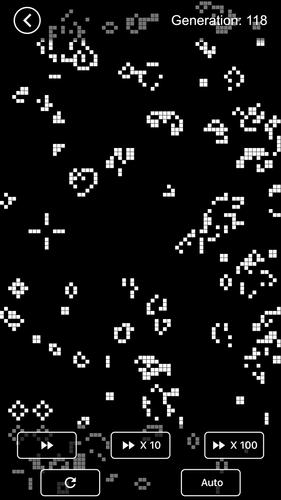
This cellular automaton unfolds on an infinite 2D grid where each cell exists in either a live or dead state. Every generation (or turn) updates cell states based on their eight immediate neighbors - those touching horizontally, vertically, or diagonally.
The starting configuration represents generation zero. Subsequent generations emerge when all cells simultaneously transition according to the rules, with births and deaths occurring at the same time. These rules dictate a cell's fate in the next generation:
A live cell survives if it has exactly 2 or 3 living neighbors
A dead cell revives only when surrounded by exactly 3 living neighbors
While infinite rule variations exist by altering neighbor thresholds, Conway rigorously tested combinations before selecting these specific parameters. Some variations lead to immediate extinction while others cause uncontrolled expansion. These chosen rules occupy a delicate balance between these extremes - precisely where the most fascinating emergent behaviors appear, blending expansive growth with stabilizing constraints.
Latest Version 0.2.2 Updates
Conway's Game of Life

Created by mathematician John Conway in 1970, Conway's Game of Life is a groundbreaking mathematical simulation.
This cellular automaton unfolds on an infinite 2D grid where each cell exists in either a live or dead state. Every generation (or turn) updates cell states based on their eight immediate neighbors - those touching horizontally, vertically, or diagonally.
The starting configuration represents generation zero. Subsequent generations emerge when all cells simultaneously transition according to the rules, with births and deaths occurring at the same time. These rules dictate a cell's fate in the next generation:
A live cell survives if it has exactly 2 or 3 living neighbors
A dead cell revives only when surrounded by exactly 3 living neighbors
While infinite rule variations exist by altering neighbor thresholds, Conway rigorously tested combinations before selecting these specific parameters. Some variations lead to immediate extinction while others cause uncontrolled expansion. These chosen rules occupy a delicate balance between these extremes - precisely where the most fascinating emergent behaviors appear, blending expansive growth with stabilizing constraints.
Latest Version 0.2.2 Updates